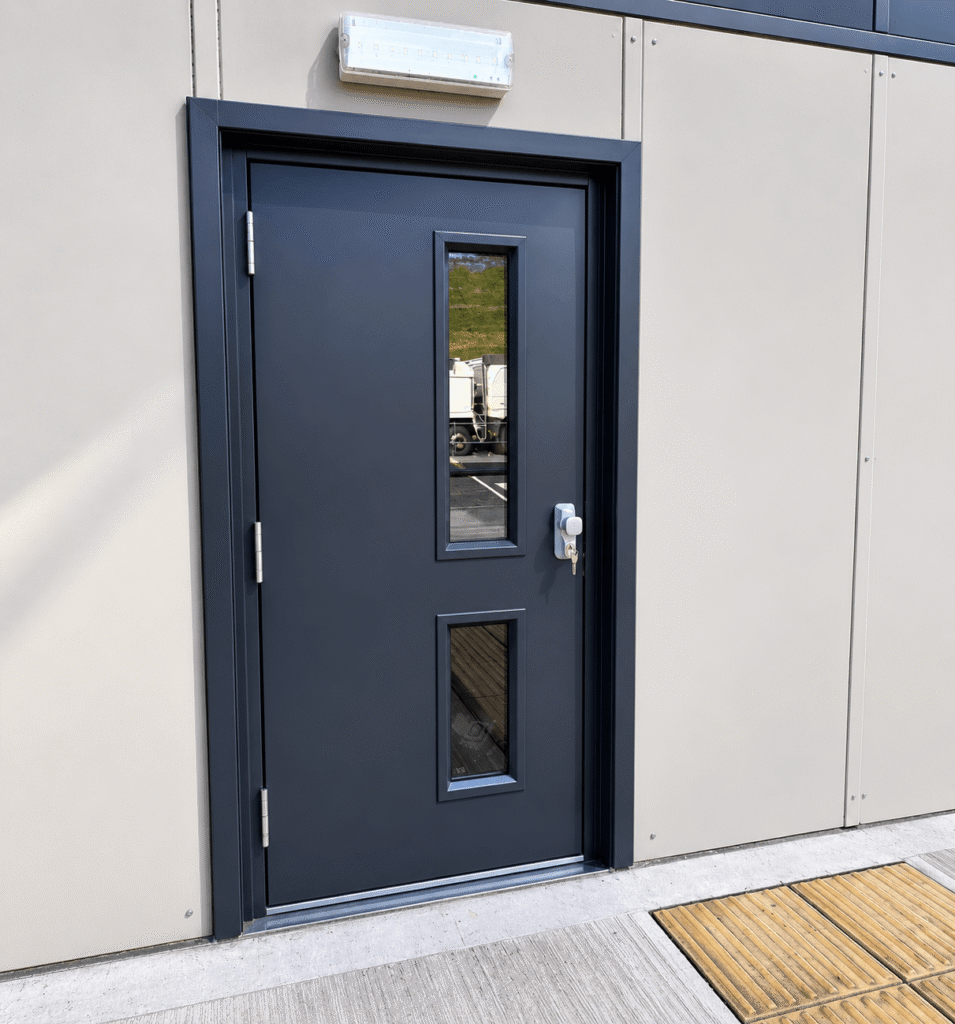
September has a way of sharpening minds. The clocks haven’t changed yet, but the evenings are already drawing in, heating systems are being switched back on, and most facilities and estates teams are working through the list of building fabric that needs attention before the cold weather sets in. Entrance doors are usually near the top of that list, and for good reason. A door that’s doing double duty as both a security barrier and a source of heat loss is costing you twice over.
This is where energy-efficient security doors earn their place. They’re not a separate product category bolted onto a standard door, they’re what happens when security specification and thermal performance are designed in together, rather than treated as a trade-off. For facilities managers specifying commercial security doors, that combination is increasingly the baseline expectation, not a nice-to-have.
Why September is the right time to look at this
Term has just started, buildings are filling back up, and heating is going back on after a summer of sitting mostly idle. For schools, leisure centres and commercial premises alike, this is the window where a poorly sealed or ageing entrance door stops being a minor niggle and starts being a visible drain on energy use, felt in draughty corridors, cold reception areas, and heating systems working harder than they should. Specifying or upgrading now, ahead of the coldest months, means the benefit is banked before winter rather than chased during it.
What makes a security door “energy-efficient”
Not every door marketed as secure is built with thermal performance in mind. The doors that genuinely perform on both counts tend to share a few features:
- A solid, insulated core rather than a thin skin over a hollow or lightly filled frame, which is what actually slows heat transfer through the door.
- Properly sealed frames and thresholds, engineered to close tight and stay tight, cutting the draughts that a worn or poorly fitted door lets straight through.
- Certified security performance – PAS 24, LPS 1175 or Secured by Design accreditation, and fire-rated security doors where the location calls for it – built into the same doorset, rather than security and insulation pulling in different directions.
- Durable construction that holds its seal and its security rating over years of daily use, not just on the day it’s installed.
The benefits, in practice
Lower heat loss, lower running costs. A well-sealed, insulated doorset reduces the heat escaping through what is often one of the largest gaps in a building’s envelope. Over a heating season, that adds up on the energy bill, particularly on buildings with high footfall entrances that are opened and closed constantly.
Security and efficiency in one specification. There’s no need to choose between a door that’s certified to PAS 24 or LPS 1175 and one that performs thermally. Specifying an energy-efficient security door means both requirements are met by a single, certified product – simpler for procurement and easier to justify at sign-off.
Fewer draughts and less condensation. Gaps around an ill-fitting door don’t just let heat out – they let cold, damp air in, which shows up as draughts, condensation and, over time, wear on the surrounding frame and finishes. A properly sealed doorset reduces all three.
Consistent internal temperatures. For buildings that rely on doors being opened and closed regularly throughout the day – schools, leisure centres, retail entrances – a well-insulated door helps the heating system maintain a steady temperature rather than constantly working to recover what’s lost every time the door opens.
A step towards wider sustainability goals. Building fabric improvements like this sit alongside other measures – lighting, glazing, heating controls – as part of a broader push to reduce a building’s energy use and carbon footprint, which matters increasingly for public sector and commercial estates alike.
Where this matters most
Energy-efficient security doors do the most work in buildings where security and thermal performance both carry real weight, and that covers more sectors than it might first appear. Schools and universities need entrances that stay secure throughout the school day while keeping classrooms and corridors warm through a long heating season. Leisure centres and sports halls open their doors constantly across a full day of footfall, which makes draught control as much a comfort issue as an energy one. Healthcare buildings run to strict infection-control and accessibility standards on top of security and warmth, so the door has to work harder on every front at once. Factories, warehouses and utilities sites often have large entrances that are among the biggest single sources of heat loss in the building. Commercial offices, retail stores and hotels all rely on entrances that are opened and closed hundreds of times a day, and apartment blocks and other residential developments need communal entrance doors that satisfy fire, security and thermal requirements together from day one.
New-build and refurbishment projects are the natural point to specify an energy-efficient security door from the outset, since the fabric performance is designed in rather than retrofitted. But the same doors are just as relevant as a like-for-like replacement on an existing building, particularly where the current doors are ageing, draughty, or falling short on accreditation. Swapping a tired, ill-fitting doorset for a certified, well-sealed one is one of the more contained pieces of building fabric work available, precisely because it’s confined to the opening itself rather than touching the wider structure.
Built to keep performing, not just to pass inspection
An energy-efficient door is only as good as its ability to hold that performance over time. A doorset that warps, sags on its hinges, or loses its seal after a couple of winters stops delivering on the thermal side long before it fails on security, and most people only notice once the draughts are already back. This is where build quality does double duty: reinforced hinge areas and heavy-duty fixings keep a door hanging true for longer, which keeps the seal tight around the frame and threshold for longer too. An adjustable frame that compensates for irregularities in the opening at installation also matters here, because a door that’s fitted slightly out of true will never seal as well as one that’s fitted flush, however good the doorset itself is. For sites in coastal or exposed locations, it’s worth asking about marine-grade specification as well, since corrosion and weathering are their own route to a failing seal.
None of this is a one-off cost either. A door that holds its performance for years is cheaper to own than one that needs adjustment, re-sealing or early replacement, even before the energy savings are counted.
Choosing the right door
When specifying, it’s worth checking a door meets the security accreditation your building needs – PAS 24 for enhanced security, LPS 1175 for higher-risk sites, or Secured by Design where the police-backed standard applies, alongside fire rating (FD30 or higher, CERTIFIRE-certified) if the location calls for it. From there, ask about the insulation and sealing detail specifically, rather than assuming it’s covered by the security spec alone. The two don’t automatically come together unless the door has been engineered that way.
It’s also worth asking a few practical questions before you commit to a spec: how the door is built (a solid, engineered core rather than a lightweight infill), how it’s sealed at the frame and threshold, how it’s tested (and to which standard), and how long it typically takes from order to installation, so the work can be planned around term dates, opening hours or a wider refurbishment programme rather than around the door supplier’s lead time.
A few common questions
Does specifying for energy efficiency mean compromising on security?
No. The doors that perform best thermally are, in practice, the same certified, well-engineered doorsets that perform best on security, because both depend on a tightly built, properly sealed structure. The two specifications reinforce each other rather than pulling in opposite directions.
Can an existing security door be upgraded, or does it need full replacement?
That depends on the condition and age of the current doorset and frame.
What should be checked first on an ageing door?
Draughts around the frame, visible gaps at the threshold, and difficulty closing the door fully are the three most common early signs that a doorset has stopped sealing properly, whatever its original rating.